

CVL Practices Continue Driving Cardiovascular Care Forward
Premier cardiologists have at least one thing in common: A passion for advancing patient care through the most innovative diagnostic and treatment technologies and approaches. Cardiovascular Logistics (CVL) recognizes the vital role that cardiology innovation plays in propelling our field forward. That’s why technological superiority is one of our core pledges, as well as a critical component of our mission to provide patients with the highest quality cardiovascular care available.
Across our platform, you’ll find cardiology practices demonstrating this commitment in action as they pioneer the latest methods for diagnosing and treating patients. This Innovation Series article highlights a few of the recent initiatives driving cardiovascular care forward at CVL.

CIS: 1st in Bayou Region to Use Innovative Venous Thrombectomy System
Removing difficult clots in the peripheral veins without clot-busting medications is possible with the Pounce™ Venous Thrombectomy System—and physicians at the Cardiovascular Institute of the South (CIS) were the first to use this solution in the Bayou Region of Louisiana. Dr. McCall Walker, an interventional cardiologist at CIS, removed venous clots in a patient’s leg using this mechanical thrombectomy device in the cardiac cath lab at Terrebonne General Health System.
Manufactured by Surmodics, the Pounce system uses a collapsible basket to capture clots in peripheral veins, along with a motorized mechanism in the basket to transport the clots from the patient’s body. As Dr. Walker noted, this thrombectomy system allows the physician to control the basket diameter to remove clots efficiently.
CCA: Enhancing Virtual Care by Partnering with an Industry Leader
With demand for virtual care skyrocketing, Capital Cardiology Associates (CCA) recently made a major leap forward by partnering with HealthSnap, a leading virtual care company. As of late last year, 33 CCA healthcare providers are offering HealthSnap’s Remote Patient Monitoring (RPM) and Principal Care Management (PCM) programs.
The partnership enables CCA to provide high-quality virtual care management for patients with hypertension, chronic heart failure, AFib, stroke, or other conditions related to cardiology. The PCM program offers disease-specific care plans and pathways for eligible patients with a single chronic condition, helping providers treat these conditions between in-office visits and comply with the associated Centers for Medicare and Medicaid Services (CMS) requirements. In addition to enhancing patient care, the move allows CCA to shed many of the logistical burdens associated with virtual care management, including RPM device logistics and relevant patient identification and outreach.
CCA also continues to apply innovative treatment techniques—recently performing a percutaneous coronary intervention (PCI) on an 84-year-old cyclist to open his blocked arteries and get him back riding again.
During a routine ride, the patient was found unconscious and brought to a hospital emergency room, where he was diagnosed with a broken collarbone. Seeking a second opinion about the cause of his loss of consciousness—and assurance he could continue cycling—he scheduled an appointment with CCA and learned he had restricted blood flow through a major artery. Within a week of his diagnosis, under Dr. Lance Sullenberger’s care, the patient underwent the minimally invasive PCI procedure, which can be the fastest and most effective way to restore circulation to the heart muscle if there is a blockage. After a sufficient recovery period, the patient was back riding again, earning several medals in a recent senior games road race.
CCC: Launching a Virtual Cardiac Recovery Program
Cardiac rehabilitation plays a critical role in improving patient outcomes. But the process can prove inconvenient for patients, and it typically involves referring out to a different provider for a revenue-generating service. Clearwater Cardiovascular Consultants (CCC) is addressing both challenges by partnering with Recora to offer an at-home Cardiac Recovery Program.
Each program is personalized to the patient’s needs, usually incorporating services such as virtual sessions on topics like exercise, diet, and stability; access to a library of educational modules; live exercise sessions; online chats; and other support resources. With a track record of reducing hospitalizations by 30 percent and boosting medication adherence to 94 percent, Recora’s Cardiac Recovery Program has the potential to improve CCC patient outcomes while helping the practice strengthen patient relationships and grow with the addition of a new service line.
FCCI: Achieving a Major Milestone with the WATCHMAN™ Implant
Many cardiology patients are prescribed blood thinners long term to reduce their risk of a stroke. But patients of First Coast Cardiovascular Institute (FCCI) have a state-of-the-art, drug-free alternative: the WATCHMAN Implant.
Dr. Firas El Sabbagh recently performed his 300th WATCHMAN Implant procedure at HCA Florida Orange Park Hospital, using this minimally invasive device designed for patients with non-valvular atrial fibrillation (AFib). Board-certified in cardiac electrophysiology, cardiovascular disease, and echocardiography, Dr. El Sabbagh is bringing the most advanced cardiovascular care to FCCI patients, using an FDA-approved device designed to permanently close off the left atrial appendage and keep blood clots from escaping. According to the manufacturer, 96 percent of people in a clinical trial were able to stop their blood thinners 45 days after receiving a WATCHMAN Implant.
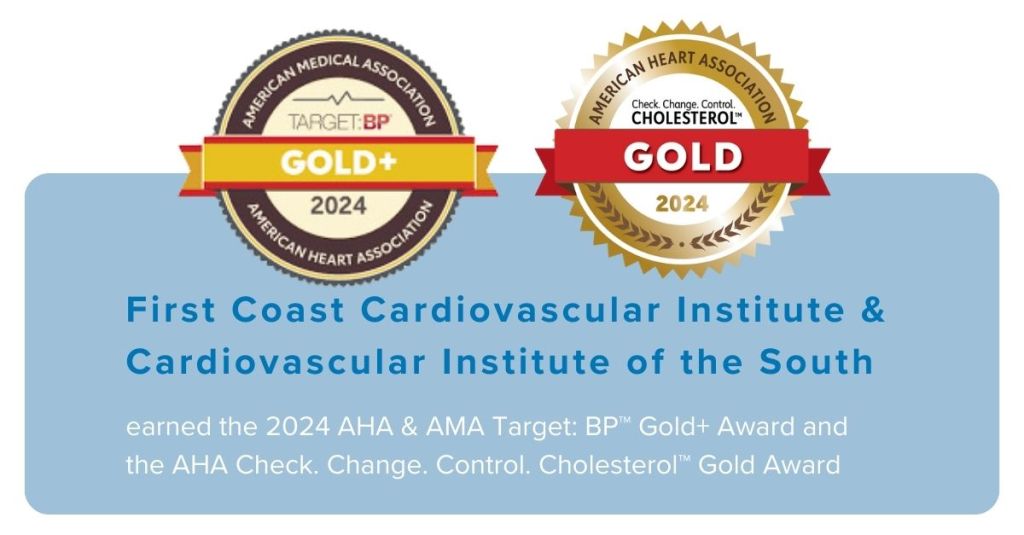
Two Gold Award Winners for Blood Pressure & Cholesterol Management
Year after year, CVL practices garner top awards from the American Heart Association (AHA) for reducing cardiac risk through blood pressure management and cholesterol management. CIS and FCCI were recent recipients of these honors.
Both practices received 2024 Gold+ Awards through Target:BP™, a joint initiative of the AHA and the American Medical Association (AMA) aimed at improving blood pressure control. This top award recognizes that CIS and FCCI far surpassed the minimum criteria of establishing a hypertension control rate of at least 70 percent in patients aged 18 to 85 (excluding those in end-stage renal disease, on dialysis, or pregnant). It’s the 7th consecutive for FCCI and 6th consecutive for CIS!
CIS and FCCI also earned Gold Awards from the Check. Change. Control. Cholesterol™ program, which acknowledges practices that are successfully managing cholesterol in at-risk patients through statin therapy where appropriate. Once again, these CVL practices far exceeded the program’s goal of at least 70 percent of adult at-risk patients with atherosclerotic cardiovascular disease (ASCVD) appropriately managing their condition with statin therapy. Awards like these recognize that CVL practices are effectively managing controllable risk factors known to increase a patient’s likelihood of a cardiovascular event.
Our commitment to innovation is one of many reasons top-tier practices choose to join CVL. They share our passion for advancing cardiovascular medicine, and they recognize that our platform provides the scale and resources to invest in advanced technologies that enhance care delivery and improve outcomes.
If you’re passionate about moving cardiovascular medicine forward and providing your patients with the best possible care, joining the CVL platform may be the best next step for your cardiology practice.
Contact CVL to discover how a partnership can help you enhance your practice’s technology and deliver the highest quality patient care.
FAQs
How are cardiology practices using innovation to improve patient care?
Leading cardiology practices are adopting advanced technologies and care models to improve outcomes and expand access for patients. These include minimally invasive procedures, remote patient monitoring programs, virtual care solutions, and at-home recovery programs—all designed to deliver more personalized, timely, and effective care for patients.
What role does virtual care play in cardiovascular treatment?
Virtual care allows cardiologists to monitor and manage patients between in-office visits, improving continuity of care and patient engagement. Programs like remote patient monitoring (RPM) and principal care management (PCM) help physicians track chronic conditions, intervene earlier, and reduce hospitalizations while maintaining compliance with regulatory requirements.
What are some examples of innovative cardiovascular treatments being used today?
Examples include mechanical thrombectomy systems for removing blood clots without medication, minimally invasive procedures like percutaneous coronary intervention (PCI) to restore blood flow, and implantable devices such as the WATCHMAN™ that reduce stroke risk without long-term blood thinners. These innovations are helping improve outcomes and recovery times for patients.
How do cardiovascular platforms support innovation across independent practices?
Cardiovascular platforms enable innovation by providing the scale, capital, and collaborative environment needed to adopt new technologies and care models. Practices can learn from each other, implement proven solutions more quickly, and expand services that improve both patient care and operational performance.
How does innovation benefit both patients and cardiology practices?
For patients, innovation leads to better outcomes, more convenient care options, and faster recovery times. For practices, it creates opportunities to expand services, strengthen patient relationships, and differentiate themselves in competitive markets while also improving efficiency and long-term growth.

Cardiology Consultants of Philadelphia Preserves Its Independence Through a Physician-Led Cardiovascular Platform
Cardiology Consultants of Philadelphia (CCP), the largest independent cardiology practice in the country with over 90 physicians across five counties,...

Capital Cardiology Associates Builds for the Future by Joining a Physician-Led Cardiovascular Platform
Capital Cardiology Associates (CCA), one of the largest independent cardiology practices in New York State, joined Cardiovascular Logistics (CVL) in...